 Skip to content

A laser profilometer is a non-contact measurement device that uses a laser beam to capture high-precision, high-resolution data of a surface’s topography. It is commonly used in construction, infrastructure, and manufacturing to perform accurate and repeatable surface inspections on roads, rails, and structural components. In large infrastructure projects, laser profilometers are often used together with technologies such as Ground Penetrating Radar (GPR) and LiDAR drone surveys to provide a complete picture of both surface and subsurface conditions. By analyzing surface texture, form, and step height, laser profilometers help ensure compliance with strict engineering tolerances and improve overall quality control processes.
How Laser Profilometers Work
Laser profilometers are precision instruments used for surface measurement. They are engineered to capture detailed surface information without making physical contact with the sample surface. These devices are critical in environments where accuracy, repeatability, and non-destructive testing are required. Modern 3D optical profilometers can achieve vertical resolution down to the nanometer level, depending on the model and measurement setup.
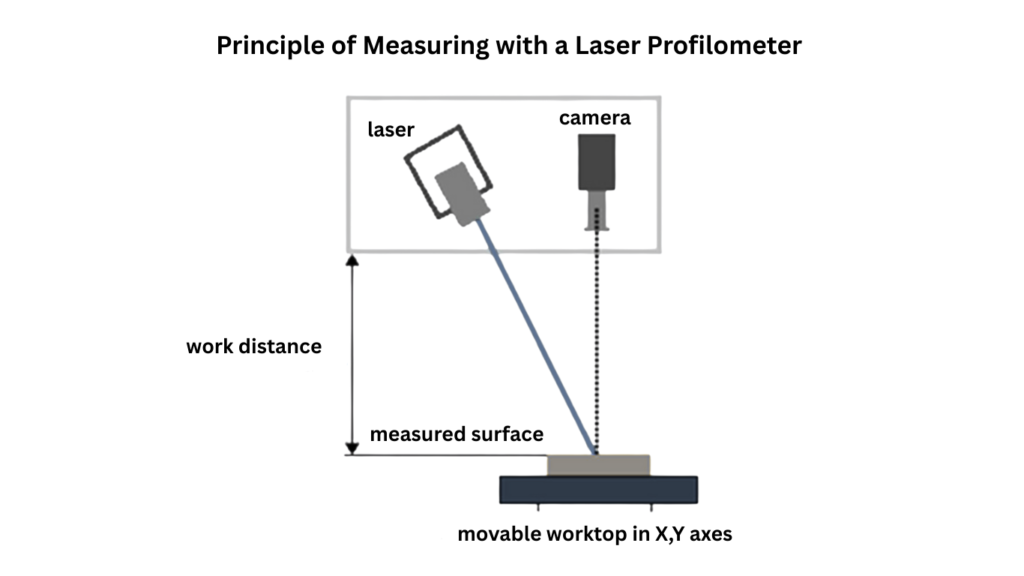
In construction, laser profilometers measure surface flatness, defects, and irregularities in pavement, rails, and concrete structures. The system operates by projecting a laser beam onto the surface and using an optical sensor to capture the reflection, calculating surface height using laser triangulation.
Profilometers are deployed for quality control in infrastructure projects, offering reliable data on surface topography, surface texture, and step height. These parameters are essential for ensuring long-term durability, alignment, and performance of roads and railways.
Core Components of a Laser Profilometer
Each laser profilometer contains several integrated components:
- Laser emitter: Projects a focused laser beam (red or blue) onto the surface.
- Optical sensor: Detects the reflected light from the sample.
- Positioning system: Moves the device across the target surface.
- Data acquisition system: Captures and processes real-time surface profile data.
- Controller/software: Handles user interface, analysis, and data storage.
The sensor system’s performance is defined by its measurement range, vertical resolution, and sensitivity to surface reflectivity. Devices may vary depending on the application. For example, mobile scanners for road inspection or bench-top systems for laboratory testing.
Principles of Laser Triangulation
Laser triangulation is the most commonly used method in profilometers. A laser beam is projected at a known angle onto the sample. The reflected light is collected by a sensor, and based on the angle shift, the system calculates the exact height of each point on the surface.
This method enables the device to measure form, texture, and thickness with high accuracy and repeatability, even on moving or vibrating surfaces. It is effective on materials with varying surface characteristics, including highly reflective or dark objects.
Triangulation-based systems offer high vertical resolution, making them suitable for applications in construction, aerospace, and electronics.
Surface Topography and Texture Analysis
Surface topography includes all the 3D features of a surface, from roughness to waviness. A laser profilometer provides a detailed analysis of these parameters, supporting engineering decisions related to friction, adhesion, and wear.
Surface texture is analyzed through parameters such as Ra (roughness average), Rz (mean peak-to-valley height), and RMS (root mean square roughness). This data is essential in construction for:
- Ensuring pavement grip and drainage
- Assessing wear on rail tracks
- Detecting micro-defects in formed concrete
Profilometers provide fast and reliable surface inspection with millimeter or micron precision, depending on system configuration.
Measurement Range and Vertical Resolution
The measurement range determines the vertical and horizontal dimensions the system can accurately capture. In construction, a wide measurement range is required to analyze large surface areas like asphalt roads or steel bridges.
High vertical resolution (down to sub-micron level) is necessary when scanning fine surface features or identifying minor defects. For example:
- Road profiling may need millimeter-range depth detection.
- Semiconductor inspection demands nanometer-level resolution.
Selecting a profilometer with the right range-resolution balance is critical for achieving repeatable measurements and precision.
Laser Profile Scanner Systems
A laser profile scanner is a high-speed system that projects a laser line rather than a single point, allowing it to scan across the width of a surface in real time. These systems are ideal for continuous or in-line inspection processes.
In road construction, they can be mounted on vehicles to scan large surface areas at high speeds. These scanners are built to withstand vibration, dust, and environmental changes, ensuring consistent performance in field applications.
They are used to:
- Monitor rail wear
- Detect pavement undulations
- Verify step height in precast elements
Laser Profilometers for Complex Geometries
Construction materials often have non-linear surfaces, grooved concrete, corrugated metal, or curved rails. Laser profilometers handle these complex geometries using adaptive optics and advanced signal processing.
The non-contact nature of the system makes it suitable for measuring hard-to-reach areas or fragile structures without risk of damaging the surface. Profilometers provide complete surface characterization, even on components with variable angles and textures.
Their ability to scan intricate shapes, corners, and angles makes them suitable for both macro surfaces (like roads) and micro samples (like semiconductors or medical devices).
This capability is critical in applications where shape accuracy affects structural performance and safety.
White Light Interferometry vs Laser Profilometry
White light interferometry is another non-contact method for measuring surface profiles. It offers higher resolution and is used primarily in laboratory settings or micro-manufacturing.
Laser profilometry, while slightly lower in resolution, excels in field environments. It offers:
- Better tolerance to vibration and environmental changes
- Faster scan times
- Easier integration with construction workflows
In construction and infrastructure, laser profilometers are more practical for routine inspections, high-speed scanning, and integration with existing systems.
3D Laser Profilometry
3D laser profilometers create full digital surface models by combining 2D scans over time or with multiple sensors. These systems are used to analyze form, step height, and defects in three dimensions.
In road and bridge inspection, 3D data helps identify depressions, cracks, or delamination. In rails, it reveals wear patterns and misalignment.
The height information captured by 3D systems improves inspection accuracy and supports predictive maintenance strategies. They can be integrated with CAD for tolerance comparison.
Red Laser vs Blue Laser: Application-Based Use
Red lasers (around 650 nm) are standard for general-purpose applications. They perform well on light-colored or matte surfaces.
Blue lasers (around 405–450 nm) are better for highly reflective or dark surfaces due to their shorter wavelength. They provide higher image contrast and are less affected by surface color variations.
In construction, blue laser profilometers are preferred when scanning reflective metals, black materials, or shiny surfaces like polished concrete or coated steel.
Optical Profilometers in Construction
Optical profilometers include both laser and white light systems. In construction, they’re used to inspect surfaces that must meet precise roughness or texture standards.
Typical uses include:
- Measuring concrete texture before coating
- Evaluating metal component surfaces for bonding
- Verifying the finish of prefabricated structures
These devices support non-contact, high-resolution scanning, ideal for both field inspections and lab analysis.
High-Speed Data Acquisition and Scanning
Modern profilometers are equipped for high-speed data acquisition, capable of scanning thousands of points per second. This enables fast coverage of large areas like highways, runways, or structural walls.
Systems can be mounted on mobile platforms, drones, or production lines to support continuous monitoring and real-time feedback. High-speed scanning reduces downtime, increases throughput, and supports rapid decision-making during construction.
Data can be stored locally or uploaded to cloud systems for further analysis and quality control documentation.
Applications in Roads and Rails
In road construction, laser profilometers are used for:
- Asphalt texture analysis
- Surface smoothness verification
- Crack detection and grading
In rail systems, they assist in:
- Monitoring wear on railheads
- Measuring alignment and straightness
- Checking for surface defects and deformation
Profilometers help ensure that infrastructure meets engineering standards, extends asset life, and reduces maintenance costs.
Precision and Repeatability in Surface Measurement
Precision refers to how finely a profilometer can measure. Repeatability ensures it provides the same result under identical conditions.
Laser profilometers are built for both. They maintain measurement accuracy across various surfaces, angles, and material types. This is essential for documenting compliance and detecting defects over time.
They are regularly calibrated and feature internal controls to maintain measurement accuracy in harsh environments.
Integration with Existing Systems and Data Storage
Most profilometers support integration with control systems, data acquisition platforms, and reporting tools. This enables automated inspection workflows and traceable quality assurance records.
Data storage is flexible. Measurements can be exported in various formats, stored in local drives, or synced with cloud platforms. Advanced software tools offer real-time visualization, statistical analysis, and trend tracking.
This connectivity supports Industry 4.0 and smart construction initiatives.
Industrial Applications: Aerospace, Automotive, Semiconductors
Beyond construction, laser profilometers are widely used in:
- Aerospace: Inspecting structural panels, engine components
- Automotive: Checking weld quality, surface flatness, paint texture
- Semiconductors: Measuring wafer thickness, pattern defects
- Medical Devices: Evaluating implant surfaces, catheter finishes
- Electronics: Inspecting PCB flatness, solder quality
Each industry benefits from non-contact, high-precision, and high-speed inspection, ensuring product quality and reliability.
Advancements and Future Outlook
Future developments focus on:
- Higher resolution and accuracy
- More compact, mobile units
- AI-based defect detection
- Integration with digital twins and BIM
- Improved efficiency through automation
Laser profilometers will continue to evolve as critical tools for surface measurement, inspection, and control in advanced construction and manufacturing environments.
FAQs
- What is the main purpose of a laser profilometer in construction?
To measure surface topography, texture, and defects in roads, rails, and structural components with high accuracy. - What industries benefit most from laser profilometers?
Construction, aerospace, automotive, semiconductor, and medical industries rely heavily on laser profilometers for accurate, non-contact surface inspection. - What is the difference between laser profilometers and optical profilometers?
Laser profilometers use focused laser beams; optical profilometers may use white light or other optical methods. Both are non-contact, but lasers are more suited to field environments. - Why is blue laser preferred for certain surfaces?
Blue lasers offer better performance on dark or reflective surfaces due to higher image contrast. - Can laser profilometers handle large surfaces?
Yes. High-speed systems can scan large areas like highways and bridges efficiently. - Are laser profilometers suitable for integration with existing inspection systems?
Yes. They support real-time data acquisition, cloud storage, and system integration for automated workflows. - Can laser profilometers detect small surface defects?
Yes, they can detect micro-level surface defects that aren’t visible to the naked eye, making them ideal for quality control. - Do laser profilometers work on shiny or reflective surfaces?
Absolutely, especially with blue laser technology, which handles reflections better than red lasers.